
George was explaining to his classmates what properties the function $f$ has if the graph was given by three line segments.
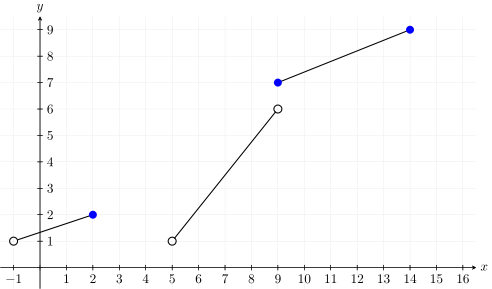
He explained that:
(1) Each of the line segments is a part of a straight line that is a graph of a linear function.
(2) Each of the line segments is a part of a straight line with a positive slope. And a linear function with a positive slope is increasing.
(3) The function $f$ is increasing on intervals $(-1;2] $, $(5;9)$, $[ 9;14] $.
(4) Since the function $f$ is increasing on intervals $(-1;2] $, $(5;9)$, $[ 9;14] $, it is also increasing on the set $(−1;2] \cup (5;9) \cup [ 9;14] $.
Did he make a mistake? If yes, determine where:
Yes, there is a mistake in the part (4). The monotonicity of the function $f$ on individual intervals cannot provide any relevant information about the monotonicity of $f$ on the union of those intervals.
Yes, there is a mistake in the part (4). Since the function $f$ is increasing on intervals $(-1;2]$, $(5;9)$, $[ 9;14]$, it is also increasing on the interval $(-1;14]$.
Yes, there is a mistake in the part (2). The monotonicity of the linear function cannot be determined by the slope of the given straight line.
Yes, there is a mistake in the part (3). Function $f$ can be increasing solely on open intervals.
No. There is no mistake in George’s explanation.
Yes, there is a mistake in the part (1). Only one line segment includes both its endpoints.
