
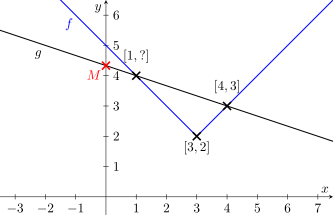
The picture shows graphs of two functions intersecting at two points. The two functions are $f(x)=k\cdot |x-m|+n$ and $g(x)=ax+b$. Find the coordinates of point $M$, where the graph of function $g$ intersects the $y$-axis.
The procedure:
(1) Using the information that the graph of the function $f$ passes through the points $[3,2]$ and $[4,3]$, we can determine that $k=1$, $m=3$, and $n=2$. Therefore: $$ f(x)=|x-3|+2 $$
(2) Next, we find coordinates of the two points where graphs intersect each other. We can observe from the picture that one of these points is the point $[4,3]$, and the second intersection point has an $x$-coordinate of $1$. We calculate its $y$-coordinate from the equation of function $f$: $$ f(1)=|1-3|+2=4 $$
Therefore, the second intersection point is $[1,4]$.
(3) Now, we need to determine the values of $a$ and $b$ for the linear function $g(x)=ax+b$. We find $a$ and $b$ by solving the following system of equations: $$ \begin{aligned} 3 & =a\cdot 4+b\cr 4 & =a\cdot 1+b \end{aligned} $$
For instance, we can isolate $b$ from both equations and compare the obtained expressions. From the first equation, we get $b=3-4a$, and from the second equation we get $b=4-a$.
Thus: $$ \begin{aligned} 3-4a & =4-a \cr -4a+a & =4-3 \cr -3a & =1 \cr a & =-\frac13 \end{aligned} $$
Next, we substitute the value of a into the equation $b=4-a$, i.e.: $$ b=4-\left(-\frac13\right)=\frac{13}{3} $$ This means that the equation of function $g$ is: $$ g(x)=-\frac13x+\frac{13}{3} $$
(4) Finally, we calculate $y$-coordinate of point $M$. The linear function $g$ intersects the $y$-axis at point $M=[0,g(0)]=[0,\frac{13}{3}]$.
Is there any mistake in the given procedure? If yes, identify where.
Yes. There is a mistake in step (1). It is true that from the picture we can determine that $m=3$ and $n=2$. However, it is not true that $k=1$. Given that function $f$ is decreasing on the interval $(-\infty ,3]$ and increasing on the interval $[ 3,+\infty )$, we must determine the value of k separately for each interval. On the interval $(-\infty ,3]$, we have $k=-1$, and on the interval $[ 3,+\infty )$, $k=1$.
Yes. There is a mistake in step (2). We cannot conclude that both graphs pass through point $[1,4]$. By substituting $x=1$ into function $f$, we obtain a point lying on function $f$, not $g$.
Yes. There is a mistake in step (3). The set of equations is incorrect. It should have been: $$ \begin{aligned} 4 & =a\cdot 3+b \cr 1 & =a\cdot 4+b \end{aligned} $$
Yes. There is a mistake in step (4). The coordinates of point $M$ are $[\frac{13}3,0]$.
No. The whole procedure is correct.
Since the function $$ f(x)=k\cdot |x-m|+n $$ is decreasing on the interval $(-\infty ,3]$ and increasing on $[ 3,+\infty )$, it is clear that $m=3$, i.e., $$ f(x)=k\cdot |x-3|+n. $$ The condition $f(3)=2$ gives us $n=2$, i.e., $$ f(x)=k\cdot |x-3|+2. $$ Finally, from $f(4)=3$ we obtain $3=k+2$, i.e., $k=1$. So, the equation of the function $f$ is: $$ f(x)=|x-3|+2. $$
