Francis was given the task: “Consider a cube $ABCDEFGH$ with points $I$ and $J$. Point $I$ is the midpoint of edge $AE$, and point $J$ lies on the edge $CG$ such that $|JC|=2|GJ|$. Construct the cross-section of the cube with the plane $IBJ$.”
Francis proceeded as follows:
(1) He drew the line segment $IB$ and claimed that it is one of the sides of the cross-section.
(2) He drew the line segment $BJ$ and identified it as another side of the cross-section.
(3) He drew the line segment $IJ$, marking its intersection with edge $DH$ as point $K$. He concluded that the resulting quadrilateral $IBJK$ is the sought cross-section (see the picture).
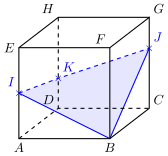
Did he proceed correctly? Explain if not.
No. There is a mistake in step (1). The line segment $IB$ is not a side of the cross-section.
No. There is a mistake in step (2). The line segment $BJ$ is not a side of the cross-section.
No. There is a mistake in step (3). Line segments $IJ$ and $DH$ do not intersect.
Yes. All steps are correct.
There is a mistake in step (3). The line segments $IJ$ and $DH$ are skew, so the intersection point $K$ does not exist. The correct procedure is as follows::
(1) Draw the line segment $IB$.
(2) Draw the line segment $BJ$.
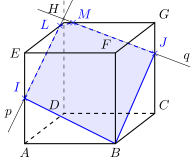
(3) Draw a line $p$ through point $I$, parallel to the line segment $BJ$, and mark its intersection with edge $EH$ as point $L$.
(4) Similarly, draw a line $q$ through point $J$, parallel to the line segment $BI$, and mark its intersection with edge $GH$ as point $M$.
(5) Draw the line segment $LM$ to obtain the pentagon $IBJML$ as the sought cross-section of the cube with the plane $IBJ$ (see the picture below).