
Hello, my name is Iva. Yesterday I solved this task:
In the picture, a quadratic function $f(x)=x^2+px+q$, where $p,q\in \mathbb{R}$, is graphed and a point $A$ is marked. Determine the coordinates of $A$.
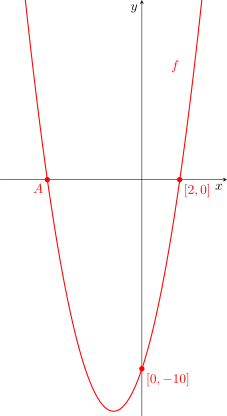
Here is my solution:
1) First, I substituted the coordinates of the point $[0;-10]$ into the equation of the function $f$, and from the resulting equation, I got $q$: $$ \begin{gather} -10=0+0p+q \cr q=-10 \end{gather} $$
2) Then, I substituted the coordinates of the point $[2; 0]$ into the same equation: $$ 0=4+2p+q $$ Using $q=-10$, I solved for $p$: $$ \begin{gather} 0=4+2p-10\cr -2p=4-10\cr -2p=-6\cr p=3 \end{gather} $$
3) I was convinced that the sum of the roots of the quadratic equation $x^2+px+q=0$ is $-p$. Since I saw on the graph of $f$ that one of the roots is $x_1=2$, I substituted it into the equation $x_1+x_2=-p$ and found the other root: $$ \begin{gather} 2+x_2=-3\cr x_2=-5 \end{gather} $$
4) I concluded that the coordinates of the point $A$ are $[-5; 0]$.
My friends then commented on my solution:
Elisabeth: „Your whole procedure of solving the task is correct but in step (4), you wrote the coordinates incorrectly. It should be $[0; -5]$.“
Michael: „There is a mistake in step (2). Applying $q=-10$ results in
$$
\begin{gather}
0=2p+6\cr
p=-3
\end{gather}
$$
You’ll need to recalculate the rest.“
Petra: „You have the correct solution, but your procedure is unnecessarily complicated. From the picture, we see that one of the roots is $x_1=2$. So, in step (2) you could have substituted this root and $q=-10$ into Vieta’s formula $x_1 \cdot x_2=q$ to get the equation $2\cdot x_2=-10$. The second root is then $x_2=-5$ and the coordinates of the point $A$ are $[-5; 0]$.“
Roman: „The steps (1) and (2) are correct but then I would have solved the problem differently. Knowing $p$ and $q$, you can write the quadratic function $f$ as: $$ f(x)=x^2+3x-10. $$ By completing the square, you find the vertex $V$ of the parabola which is the graph of the function $f$: $$ \begin{gather} f(x)=x^2+3x-10=x^2+3x+\left(\frac32\right)^2-\left(\frac32\right)^2-10=\left(x+\frac32\right)^2-\frac{49}{4} \cr V=\left[-\frac32; -\frac{49}{4}\right] \end{gather} $$ The point $A$ is centrally symmetric to the point $[2; 0]$ with respect to the point $[-\frac32; 0]$. Thus the first coordinate of the point $A$ is: $$ -\frac32-2=-\frac72 $$ Therefore, the correct coordinates of the point $A$ are $\left[-\frac72; 0\right]$.“
Who did NOT make a mistake in their comment?
Petra
Elisabeth
Michael
Roman
Iva solved this task correctly.
Petra suggested another, also correct, solution using Vieta's formulas:
The roots $x_1$ and $x_2$ of the quadratic equation $ax^2+bx+c=0$ satisfy the following equations: $$ x_1+x_2=-\frac{b}{a},~~~x_1\cdot x_2=\frac{c}{a} $$
Elisabeth wrote the final coordinates incorrectly. If the point $A$ is on the $x$-axis, then the second coordinate is zero.
Michael incorrectly corrected the step (2).
Roman proceeded correctly, however he miscalculated the first coordinate of the point $A$. The correct calculation should have been: $$ -\frac32-\frac32-2=-\frac{10}2=-5 $$
