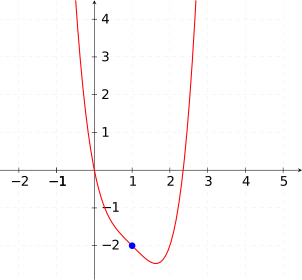
John was tasked with finding the inflection points of the graph of the function: $$ f(x)=x^4-4x^3+6x^2-5x $$ He presented the following solution:
(1) First, he decided to find the second derivative: $$ f''(x)=12x^2-24x+12 $$
(2) Then, he set the second derivative equal to zero and got the equation: $$ 12x^2-24x+12=0 $$
(3) He simplified the equation to: $$ x^2-2x+1=0 $$ and rewriting the left side as $(x-1)^2$, he obtained: $$ (x-1)^2=0 $$ He stated, that the only solution to this equation is $x=1$.
(4) By substituting $x=1$ into the function formula, John calculated: $$ f(1)=1^4-4 \cdot 1^3+6 \cdot 1^2-5 \cdot 1=-2 $$ and concluded that the point $[1;-2]$ is therefore the inflection point of the graph of the function $f$.
Is his solution correct? If not, identify the step in which John made a mistake.
Yes. The way of solving this problem is correct.
No. He made a mistake in step (1). The second derivative is incorrect.
No. He made a mistake in step (3). The equation has two solutions $x=1$ and $x=-1$.
No. The mistake is in step (4). The point [$1;-2]$ is not the inflection point.
No. The whole solution is wrong. The first derivative should be set equal to zero to get the inflection points.
In an inflection point, the second derivative (if it exists) must be equal to $0$. At the same time, at an inflection point, the second derivative must also change sign, corresponding to the change of a function from strictly convex to strictly concave behavior, or vice versa. In our problem, we have $$ f''(x)=12x^2-24x+12=12 \cdot (x^2-2x+1)=12(x-1)^2, $$ which is an expression that is never negative. This means that the function $f$ is convex on $\mathbb{R}$, which is evident form its graph as well (see the figure). Therefore, the point $[1;-2]$ is not an inflection point.