
Sophia and Olivia were to solve this task:
In a right-angled triangle $ABC$ with a right angle at vertex $C$, let us denote the angle at vertex $A$ as $\alpha$ (i.e., $\measuredangle BAC=\alpha$). For angle $\alpha$, the following holds
$$\sin \alpha =\cos \alpha.$$
The length of the hypotenuse is $2$. Determine the area of the circle inscribed in this triangle.
Sophia presented her solution.
(1) She sketched a picture of a right-angled triangle with a circle inscribed in it:
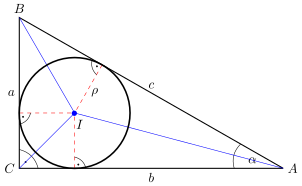
(2) She noticed that the area $P$ of $\Delta ABC$ can be expressed in terms of the lengths of its sides and the length $\rho$ of the radius of the inscribed circle: $$ P=\frac12 a\rho +\frac12 b\rho +\frac12 c\rho =\frac12 \rho (a+b+c) $$
(3) From there she expressed the radius $\rho$ : $$ \rho =\frac{2P}{a+b+c} $$ (4) Then she continued this way: $$ \begin{gather} \sin \alpha =\cos \alpha \Rightarrow \frac{a}{c}=\frac{b}{c} \Rightarrow a=b \cr a^2+a^2=2^2 \cr a=\sqrt{2} \end{gather} $$ (5) Finally, she calculated the area $P$ and the radius $\rho$: $$ \begin{gather} P=\frac{ab}{2}=1 \cr \rho =\frac{2}{\sqrt{2}+\sqrt{2}+2} =\frac{1}{\sqrt{2}+1} \end{gather} $$ (6) Now she could determine the area $A$ of the inscribed circle: $$ A =\pi\rho^2=\frac{\pi}{3+2\sqrt{2}} $$
Here is Olivia's solution:
(1) She used the fact that $\sin \alpha = \cos \alpha$, which implies that $\alpha =\frac{\pi}{4}$ and that $\Delta ABC$ is an isosceles right-angled triangle.
(2) She sketched an isosceles right-angled triangle with an inscribed circle.
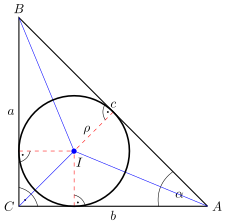
(3) She knew that the bisector of the vertex angle of an isosceles right-angled triangle is the perpendicular bisector of the hypotenuse, so: $$ \tan \frac{ \alpha}{2}=\frac{\rho}{1} $$
(4) She remembered tangent half-angle formula $$ \tan \frac{ \alpha}{2}=\sqrt{\frac{1-\cos \alpha}{1+\cos \alpha}} $$ and expressed the radius $\rho$ in the form: $$ \rho =\sqrt{\frac{1-\frac1{\sqrt{2}}}{1+\frac1{\sqrt{2}}}}=\sqrt{\frac{\sqrt{2}-1}{\sqrt{2}+1}} $$
(5) Finally, she calculated the area $A$ of the inscribed circle: $$ A =\pi\rho^2=\frac{\sqrt{2}-1}{\sqrt{2}+1} \pi $$
The teacher asked their classmates for comments. Determine which comment is correct.
Karel is convinced that they both solved the task correctly.
Libor thinks that both solutions are not right. They both made an error in calculating the radius $\rho$.
Mark is persuaded that Olivia made a mistake in step (4). It should have been: $$ \tan \frac{ \alpha}{2}= \frac{\sin \frac{ \alpha}{2}}{\cos\frac{\alpha}{2}} =1,~\rho =1 $$
Kate thinks that Olivia made a mistake in step (3). She simplified the example by considering that the bisector of the vertex angle of an isosceles right triangle divides the hypotenuse into equal parts, which may not be the case in general.
$$\frac{\sqrt{2}-1}{\sqrt{2}+1}\cdot \frac{\sqrt{2}+1}{\sqrt{2}+1}= \frac{1}{3+2\sqrt{2}}$$

