The sum of the first two terms of a geometric sequence is \( 28 \) and its first term equals \( 2 \). Which of the following statements about its common ratio \( q \) is not valid?
The sum of the first four terms of a geometric sequence is \( 0 \) and the first term equals \( 2 \). Choose the correct formula to find the eighth term.
The third term of a geometric sequence is \( -5 \) and the eighth term is \( -5 \). \( s_5 \) is the sum of the first five terms and \( q \) is the common ratio of this sequence. Choose the formula which is not valid for this sequence:
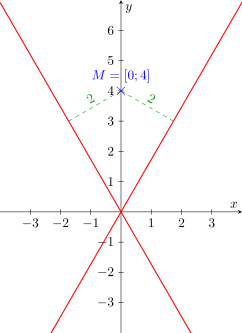
Find the straight lines passing through the coordinate origin at the distance of \( 2 \) from the point \( M=[0;4] \). Express their equations in the slope-intercept form.
Find the distance between parallel lines \( p \) and \( q \) given by their parametric equations.
\begin{align*}
p\colon x&=3+3t, & q\colon x&=2-3s, \\
y&=-1+t;\ t\in\mathbb{R}; & y&=1-s;\ s\in\mathbb{R}.
\end{align*}
Find the distance between parallel lines \( p \) and \( q \), if they are given by slope-intercept form equations, where \( p \) is \( y=-3x+5 \) and \( q \) is \( y=-3x-1 \).
Find the distance between parallel lines \( p \) and \( q \), if they are given by their general form equations, where \( p \) is \( 2x-4y+5=0 \) and \( q \) is \( x-2y+3=0 \).
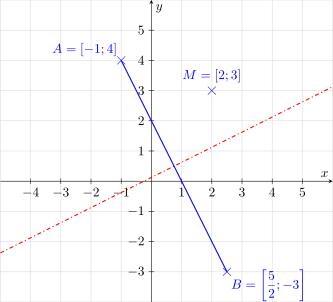
Find a general form equation of the straight line that passes through the point \( M=[2;3] \) and is parallel with the line of symmetry of the line segment \( AB \), where \( A=[-1;4] \), and \( B=\left[\frac52;-3\right] \) (see the picture).
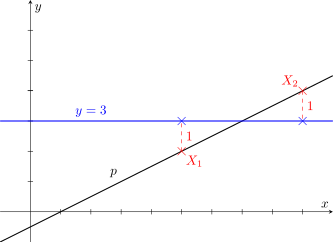
Let \( p \) be the line with the equation \( x-2y-1=0 \). Find the coordinates of all points lying on the line \( p \) such that their distance from the line \( y=3 \) equals to \( 1 \).