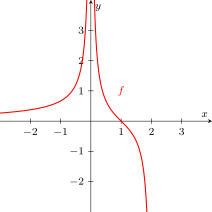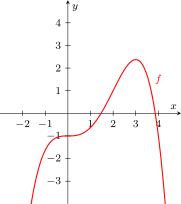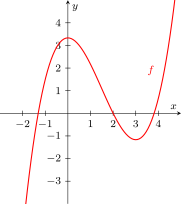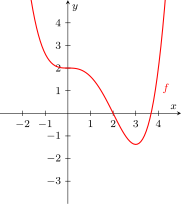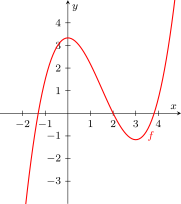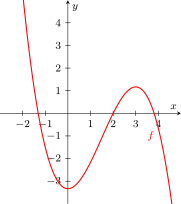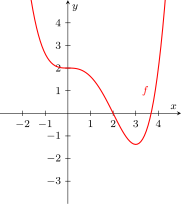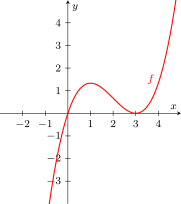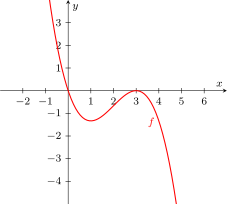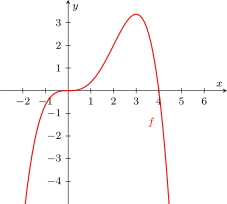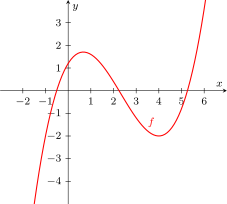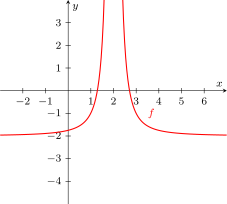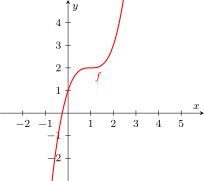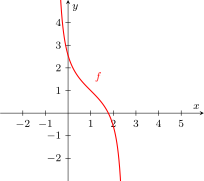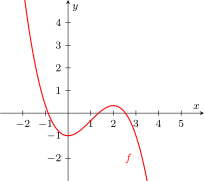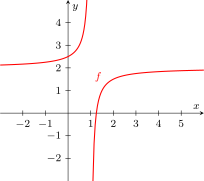
Choose the graph of a function $f$ that satisfies
\begin{gather*}
f'(0) \text{ does not exist}; \\
f''(x) > 0 \text{ if } x < 0 ; \\
f''(x) > 0 \text{ if } x > 1; \\
f''(x) < 0 \text{ if } 0 < x < 1
\end{gather*}
($f'$ is the derivative of a function $f$, $f''$ is the second derivative of a function $f$).
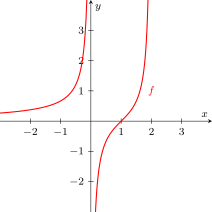
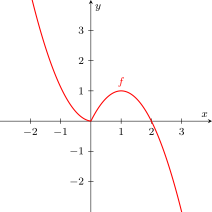
Choose the graph of a function $f$ that satisfies
\begin{gather*}
f'(0)=f'(3)=0; \\
f''(0)=0;\ f''(3) < 0
\end{gather*}
($f'$ is the derivative of a function $f$, $f''$ is the second derivative of a function $f$).
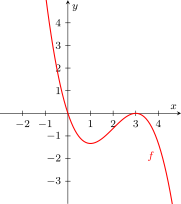
Choose the graph of a function $f$ that satisfies
\begin{gather*}
f'(0)=f'(3)=0; \\
f''(0) < 0;\ f''(3) > 0
\end{gather*}
($f'$ is the derivative of the function $f$, $f''$ is the second derivative of the function $f$).
Given the points $A = [3;3;0]$ and $B = [0;3;3]$, specify all the points $C$ lying on the $y$-axis, such that $|\measuredangle ABC|=\frac{\pi}3$ holds.
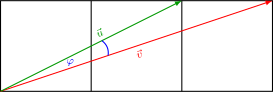
In the picture, there are indicated vectors $\vec{u}$ and $\vec{v}$ in three squares. Find the measure of an angle $\varphi$ between $\vec{u}$ and $\vec{v}$. Round $\varphi$ to the nearest degree.
Hint: Set up a coordinate system conveniently.