B

1103030502

Level: 
B
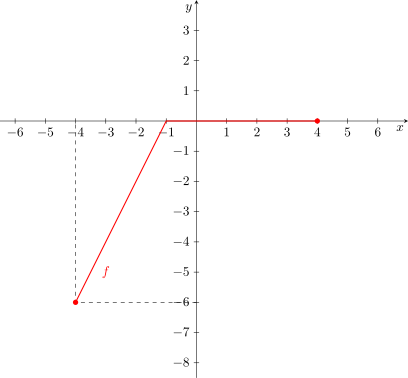
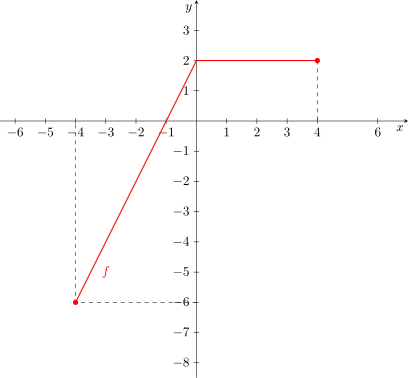
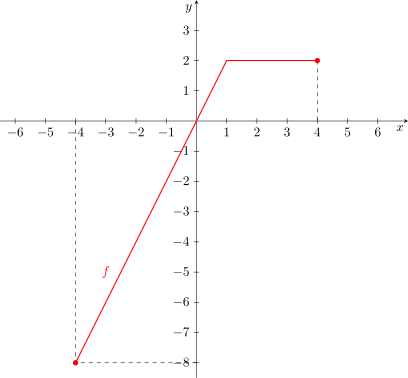
Find the coordinates of the vectors \( \overrightarrow{u} \) and \( \overrightarrow{v} \) given by the picture and evaluate their dot product.
\( \overrightarrow{u}=(-3;6);\ \ \overrightarrow{v} =(-9;-6);\ \ \overrightarrow{u}\cdot\overrightarrow{v} = -9 \)
\( \overrightarrow{u}=(3;-6);\ \ \overrightarrow{v} =(9;6);\ \ \overrightarrow{u}\cdot\overrightarrow{v} = -9 \)
\( \overrightarrow{u}=(-3;6);\ \ \overrightarrow{v} =(-9;-6);\ \ \overrightarrow{u}\cdot\overrightarrow{v} = 9 \)
\( \overrightarrow{u}=(3;-6);\ \ \overrightarrow{v} =(9;6);\ \ \overrightarrow{u}\cdot\overrightarrow{v} = 0 \)

1103030501

Level: 
B
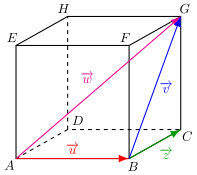
The vectors \( \overrightarrow{u} \), \( \overrightarrow{v}\), \( \overrightarrow{w} \), \( \overrightarrow{z} \) are indicated in a cube shown in the figure. The cube edge length is \( 1 \). Find the dot products of: \[ \overrightarrow{v}\cdot\overrightarrow{z}\text{ ,}\ \ \overrightarrow{u}\cdot\overrightarrow{v} \text{ ,}\ \ \overrightarrow{w}\cdot\overrightarrow{u}\]
\( \overrightarrow{v}\cdot\overrightarrow{z}=1 \), \( \overrightarrow{u}\cdot\overrightarrow{v}=0 \), \( \overrightarrow{w}\cdot\overrightarrow{u}=1 \)
\( \overrightarrow{v}\cdot\overrightarrow{z}=\frac{\sqrt2}2 \), \( \overrightarrow{u}\cdot\overrightarrow{v}=1 \), \( \overrightarrow{w}\cdot\overrightarrow{u}=\sqrt3 \)
\( \overrightarrow{v}\cdot\overrightarrow{z}=\sqrt2 \), \( \overrightarrow{u}\cdot\overrightarrow{v}=0 \), \( \overrightarrow{w}\cdot\overrightarrow{u}=1 \)
\( \overrightarrow{v}\cdot\overrightarrow{z}=1 \), \( \overrightarrow{u}\cdot\overrightarrow{v}=1 \), \( \overrightarrow{w}\cdot\overrightarrow{u}=\sqrt3 \)

1003028407

Level: 
B
Paul went by car from Ostrava to Olomouc for a business trip. There he spent \( 50 \) minutes at the meeting and then he went back the same way. Paul covered the distance of \( 98\,\mathrm{km} \) from Ostrava to Olomouc in \( 64 \) minutes. The distance back he covered in \( 66 \) minutes. Suppose the recording of the travelled distance and the time spent on the business trip started when Paul left Ostrava. Dependence of this distance on the time describes the function \( s(t) \). Distance is in kilometres and time is in hours. Which of the following statements about the domain and the range of the function \( s \) is correct?
\( D(s)=[0;3] ; H(s)=[0;196] \)
\( D(s)=[0;196] ; H(s)=[0;3] \)
\( D(s)=[0;3] ; H(s)=[0;98] \)
\( D(s)=\left[0;\frac{13}6\right] ; H(s)=[0;196] \)

1003028404

Level: 
B
Let \( f(x)=\frac{\sqrt{x+3}}{x^2-25} \). Which of the statements about the domain of the function \( f \) is true?
\( D(f)=[-3; 5)\cup (5;\infty) \)
\( D(f)=(-3;5)\cup(5;\infty) \)
\( D(f)=(-\infty;-5)\cup(-5;5)\cup(5;\infty) \)
\( D(f)=(-\infty;-5)\cup(-5;-3)\cup(-3;5)\cup(5;\infty) \)