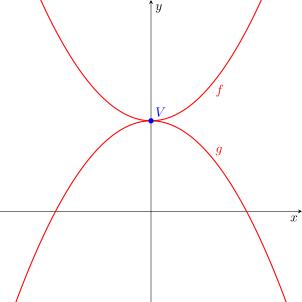
The graphs of the quadratic functions \( f \) and \( g \) are shown in the picture. The graph of \( g \) is the reflection of the graph of \( f \) about \( y \)-axis. Identify which of the following statements about \( f \) and \( g \) is true.
The equations of \( f \) and \( g \) differ in the sign of the coefficient at the linear term only.
The equations of \( f \) and \( g \) differ in the sign of the coefficient at the quadratic term only.
The equations of \( f \) and \( g \) differ in in the sign of the coefficient at the absolute term only.
The quadratic functions \( f \) and \( g \) that have the same vertex \( V \) are graphed in the picture. The graph of \( g \) is the reflection of the graph of \( f \) in the vertex \( V \). Also, both the graphs are symmetric across \( y \)-axis. Identify the true statement about \( f \) and \( g \).
The equations of \( f \) and \( g \) differ in the sign of the coefficient at the quadratic term only.
The equations of \( f \) and \( g \) differ in the sign of the coefficient at the linear term only.
The equations of \( f \) and \( g \) differ in the sign of the coefficient at the absolute term only.
Let \( [x,y]\in\mathbb{R}\times\mathbb{R} \), \( z_1 = 5 + xy\,\mathrm{i} \) and \( z_2 = x + y - 4\,\mathrm{i} \). Find all \( [x,y] \) such that \( z_1 \) and \( z_2 \) are the complex conjugates.