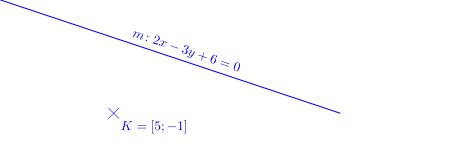
From the following list choose the equation of a straight line that passes through the given point \( K \) and is not perpendicular to the given line \( m \) (see the picture).
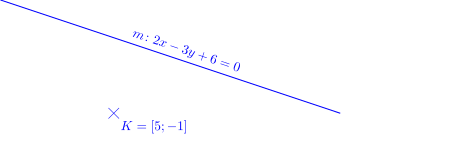
From the following list choose the equation of a straight line that passes through the given point \( K \) and is not parallel to the given line \( m \) (see the picture).
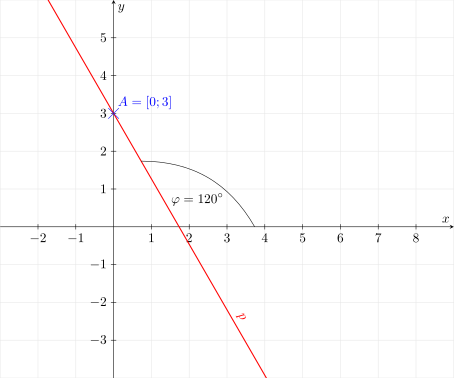
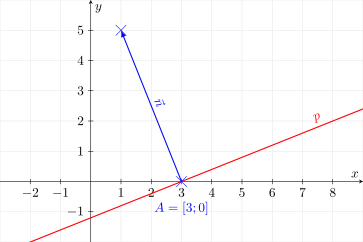
A straight line \( p \) is given by the point \( A \) and the direction angle \( \varphi \) (see the picture). Choose the equation of the line \( p \) in the slope-intercept form.
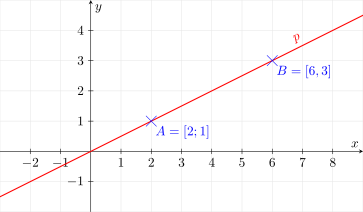
From the following list, choose parametric equations, that do not represent the straight line passing through the points \( A \) and \( B \) (see the picture).
We are given the line segment \( AB \):
\begin{align*}
x&=2+2t, \\
y&=-1+t;\ t\in [0;1],
\end{align*}
and the points \( K=\left[\frac72;-\frac14\right] \), \( L=[-2;-3] \) and \( M=\left[5;\frac12\right] \). Choose a picture where the mutual position of the points \( A \), \( B \), \( K \), \( L \), and \( M \) is indicated correctly.
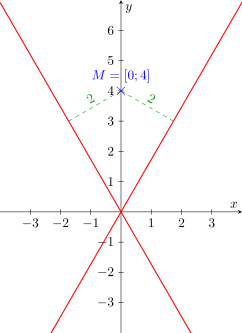
Find the straight lines passing through the coordinate origin at the distance of \( 2 \) from the point \( M=[0;4] \). Express their equations in the slope-intercept form.
Find the distance between parallel lines \( p \) and \( q \) given by their parametric equations.
\begin{align*}
p\colon x&=3+3t, & q\colon x&=2-3s, \\
y&=-1+t;\ t\in\mathbb{R}; & y&=1-s;\ s\in\mathbb{R}.
\end{align*}
Find the distance between parallel lines \( p \) and \( q \), if they are given by slope-intercept form equations, where \( p \) is \( y=-3x+5 \) and \( q \) is \( y=-3x-1 \).