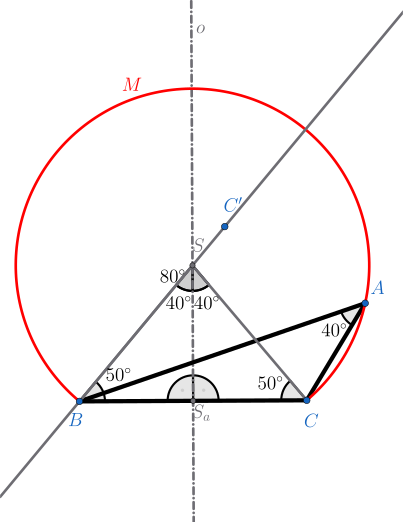
Paula was asked to construct one triangle $ABC$ that satisfies the following conditions: $a =|BC|=6\,\mathrm{cm}$, $\alpha =|\measuredangle BAC|=50^{\circ}$, $t_a=4\,\mathrm{cm}$ (where $t_a$ is the median to side $a$).
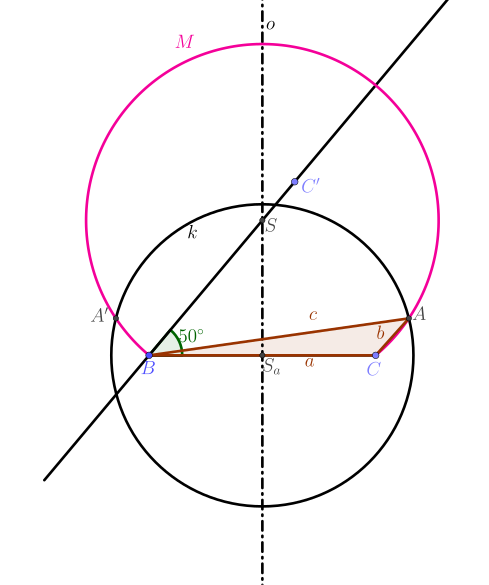
She proceeded as follows (see the picture):
(1) She drew the line segment $BC$ of length $6\,\mathrm{cm}$.
(2) She found the midpoint $S_a$ of the line segment $BC$ and claimed that this point belongs to the median $t_a$ of triangle $ABC$.
(3) She constructed a circle $k$ centered at $S_a$ with a radius of $t_a= 4\,\mathrm{cm}$ and claimed that point $A$ belongs to the circle $k$.
(4) She rotated point $C$ about point $B$ by an angle of $\alpha =50^{\circ}$ in the counterclockwise direction and obtained point $C'$. Then she constructed the line $BC'$ and marked the point where it intersects the perpendicular bisector $o$ of side $BC$ as point $S$.
(5) She constructed the set of points $M$ from which the line segment $BC$ is visible at an angle of $\alpha = 50^{\circ}$. This set forms the interior points of a certain arc of a circle with center at point $S$ and radius $|SB|$. She then claimed that point $A$ belongs to the set $M$.
(6) She found the intersection of the set $M$ and circle $k$, obtained two points, choose one of them, and marked it as vertex $A$.
(7) She completed the construction of triangle $ABC$.
Did she make any mistake? If yes, identify where.
Yes, she made a mistake in step (2). Point $S_a$ does not belong to the median $t_a$ of triangle $ABC$.
Yes, she made a mistake in step (3). Point $A$ does not belong to circle $k$.
Yes, she made a mistake in step (5). Point $A$ does not belong to the set $M$.
Yes, she made a mistake in step (6). It is not correct to choose an arbitrary point from the intersection of the set $M$ with circle $k$.
No, all steps are correct.
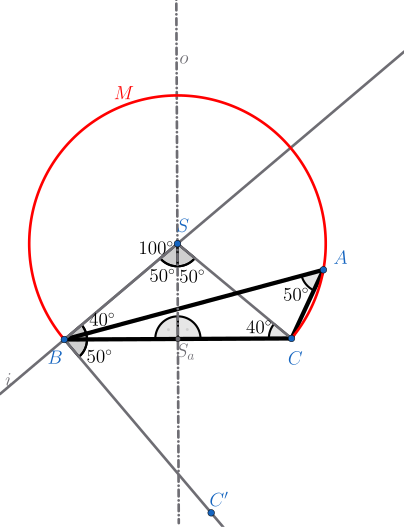
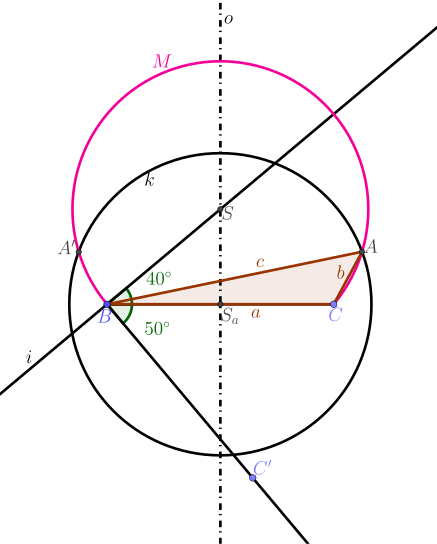
The correct procedure is as follows (see the picture):
(1) Draw the line segment $BC$ of length $6\,\mathrm{cm}$.
(2) Find the midpoint $S_a$ of the line segment $BC$.
(3) Construct a circle $k$ centered at $S_a$ with radius $t_a=4\,\mathrm{cm}$.
(4) Rotate point $C$ about point $B$ by an angle $\alpha =50^{\circ}$ in the clockwise direction to obtain point $C'$. Then construct the ray $BC'$ and the line $i$ perpendicular to the ray $BC'$ and passing through point $B$. Finally, mark the intersection point of line $i$ and the perpendicular bisector $o$ of side $BC$ as point $S$.
(5) Construct the set of points $M$ from which the line segment $BC$ is visible at an angle $\alpha = 50^{\circ}$ (these are the interior points of an arc of a circle with center at point $S$ and radius $|SB|$).
(6) Find the intersection points of the set $M$ and circle $k$ (there are two points). Select one of them, and mark it as vertex $A$.
(7) Construct triangle $ABC$.
We use the fact that the measure of a central angle is twice the measure that of the corresponding inscribed angle. Hence, if the inscribed angle measure is $50^{\circ}$, then the corresponding central angle must measure $100^{\circ}$.
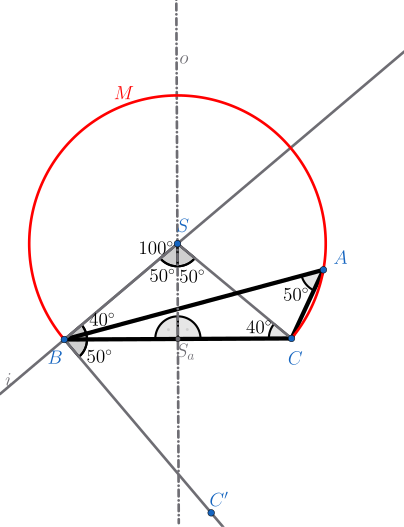
Note: In Paula’s incorrect construction, the central angle would measure $80^{\circ}$, so the corresponding inscribed angle would measure $40^{\circ}$ (see the picture below).