Hannah was tasked with constructing a cross-section of a cube. The task stated:
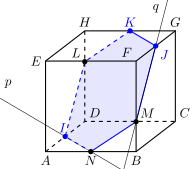
"Consider the cube $ABCDEFGH$ with points $I$, $J$, and $K$. Point $I$ is the midpoint of edge $AD$, point $J$ is the midpoint of edge $FG$, and point $K$ is the midpoint of edge $GH$. Construct the cross-section of the cube determined by the plane $IJK$."
Hannah proceeded as follows (see the picture below):
(1) She drew the line segment $JK$ and claimed that it is one of the sides of the cross-section.
(2) She constructed a line $p$ passing through point $I$ and parallel to the line segment $JK$. She marked its intersection with edge $AB$ as point $N$ and claimed that the line segment $IN$ is another side of the cross-section.
(3) She found the intersection of edges $EF$ and $DH$ and marked it as point $L$.
(4) She drew line segments $IL$ and $LK$ and claimed that they are two other sides of the cross-section.
(5) She drew the line $q$ passing through point $J$, parallel to the line segment $IL$, and marked its intersection with edge $BF$ as point $M$. She claimed that the line segment $JM$ is also a side of the cross-section.
(6) She marked the hexagon $INMJKL$ as the desired cross-section.
Did Hannah find the correct cross-section? If not, identify where the first error occurred.
Yes. She found the correct cross-section.
No. The first mistake is in step (2). The line segment $IN$ is not a side of the sought cross-section.
No. The first mistake is in step (3). There is no intersection of the edges $EF$ and $DH$.
No. The first mistake is in step (4). The line segment $IL$ is a side of the cross section, but the line segment $LK$ is not.
No. The first mistake is in step (4). The line segment $LK$ is a side of the cross section, but the line segment $IL$ is not.
No. The first mistake is in step (5). The line segment $JM$ is not a side of the sought cross-section.
The mistake is in step (3). There is no intersection of the edges $EF$ and $DH$ because the lines $EF$ and $DH$ are skew.
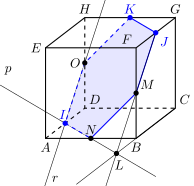
Hannah could have proceeded correctly as follows (see the picture below):
(1) Draw the line segment $JK$.
(2) Construct the line $p$ passing through point $I$, parallel to the line segment $JK$, and mark its intersection with edge $AB$ as point $N$.
(3) Construct an auxiliary point $L$ as the intersection of the ray $CB$ and the line $p$.
(4) Mark the intersection of edge $BF$ and line segment $JL$ as point $M$.
(5) Construct the line $r$ passing through point $I$, parallel to the line segment $JM$, and mark its intersection with edge $DH$ as point $O$.
(6) Mark the hexagon $INMJKO$ as the desired cross-section.