Given the parametric equations of the plane:
$$\rho:\quad \left.\begin{aligned} x&=1-2r+s\cr y&=-2+4r-5s\cr z&=1+r+2s\end{aligned}\right\} \ r,s\in\mathbb{R} $$ and the parametric equations of the line: $$q:\quad \left.\begin{aligned} x&=3+t\cr y&=t\cr z&=1-3t \end{aligned}\right\} \ t\in\mathbb{R}, $$
Determine the relative position of the plane $\rho$ and the line $q$.
George solved the problem in the following steps:
(1) He determined the coordinates of the direction vector of the line $q$: $$\overrightarrow{u}=(1,1,-3)$$
(2) Then, he determined the coordinates of the direction vectors $\overrightarrow{v}$ and $\overrightarrow{w}$ of the plane $\rho$ and used them to calculate the coordinates of its normal vector $\overrightarrow{n_{\rho}}$: \begin{aligned} \overrightarrow{v}&=(-2,4,1)\cr \overrightarrow{w}&=(1,-5,2) \end{aligned} \begin{aligned} \overrightarrow{n_{\rho}}=\overrightarrow{v}\times\overrightarrow{w}&=(4\cdot2-(-5)\cdot 1,1\cdot1-2\cdot(-2),-2\cdot(-5)-1\cdot4)=\cr &=(8+5,1+4,10-4)=(13,5,6) \end{aligned}
(3) He checked if the vectors $\overrightarrow{u}$ and $\overrightarrow{n_{\rho}}$ are linearly dependent, i.e., whether the vector $\overrightarrow{n_{\rho}}$ is a $k$ multiple of the vector $\overrightarrow{u}$, where $k\in\mathbb{R}$: \begin{aligned} 13&=k\cdot1\Rightarrow k=\frac{1}{13}\cr 5&=k\cdot1\Rightarrow k=\frac15\cr 6&=k\cdot(-3)\Rightarrow k=-\frac12 \end{aligned} George argued that there is no $k$ such that $\overrightarrow{n_{\rho}}=k\cdot\overrightarrow{u}$, and therefore, the vectors $\overrightarrow{u}$ and $\overrightarrow{n_{\rho}}$ are linearly independent (are not linearly dependent).
(4) He concluded that since the vectors $\overrightarrow{u}$ and $\overrightarrow{n_{\rho}}$ are linearly independent, the line $q$ intersect the plane $\rho$.
Is George's solution correct? If not, determine where George made a mistake.
George's solution is correct.
The mistake is in step (1). George incorrectly determined the coordinates of the direction vector $\overrightarrow{u}$ of the line $q$.
The mistake is in step (2). George incorrectly calculated the coordinates of the normal vector $\overrightarrow{n_{\rho}}$ of the plane $\rho$.
The mistake is in step (3). It is not true that the vectors $\overrightarrow{u}$ and $\overrightarrow{n_{\rho}}$ are linearly independent. It is obvious that there exists $k$ such that $\overrightarrow{n_{\rho}}= k\cdot\overrightarrow{u}$.
The mistake is in step (4). The fact that the normal vector of the plane and the direction vector of the line are linearly independent is not sufficient to determine the relative position of the line and the plane.
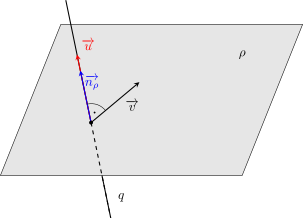
If the vectors $\overrightarrow{u}$ and $\overrightarrow{n_{\rho}}$ are linearly dependent, the line is perpendicular to the plane, i.e., the line intersects the plane (figure d)).
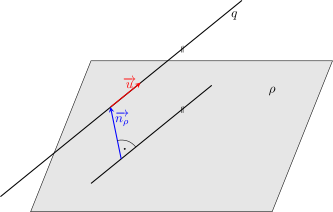
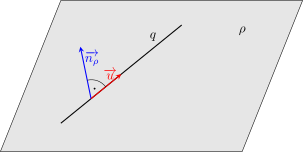
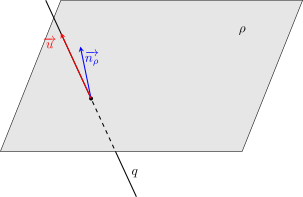
If the vectors $\overrightarrow{u}$ and $\overrightarrow{n_{\rho}}$ are linearly independent, there are three options: The line and the plane are parallel (figure a)), the line lies directly in the plane (figure b)), or the line intersects the plane (figure c)). Which of these options occurs can be decided by the following procedure.
To use the direction vector $\overrightarrow{u}$ of the line $q$ and the normal vector $\overrightarrow{n_{\rho}}$ of the plane $\rho$ to determine the relative position of $q$ and $\rho$, it is better to find out whether the vectors are perpendicular.
If $\overrightarrow{n_{\rho}}$ and $\overrightarrow{u}$ are perpendicular, then the line $q$ is parallel to the plane $\rho$ (figure a)) or the line $q$ lies in the plane $\rho$ (figure b)).
If $\overrightarrow{n_{\rho}}$ and $\overrightarrow{u}$ are not perpendicular, then the line $q$ intersects the plane $\rho$ (figure c) or d)).
The vectors $\overrightarrow{u}$ and $\overrightarrow{n_{\rho}}$ are perpendicular if $\overrightarrow{u}\cdot\overrightarrow{n_{\rho}}=0$. So we check this condition: $$\overrightarrow{u}\cdot\overrightarrow{n_{\rho}}=1\cdot13+1\cdot5+(-3)\cdot6=13+5-18=0$$
We have found that the vectors $\overrightarrow{u}$ and $\overrightarrow{n_{\rho}}$ are perpendicular. Therefore, the line $q$ is either parallel to the plane $\rho$ or the line $q$ lies in the plane $\rho$. Now we will determine which of these alternatives is true:
From the parametric equations of the line $q$, we determine the coordinates of its point $A$: $$A=[3; 0; 1]$$ We check if $A$ also lies in the plane $\rho$:
$$\underline{\begin{aligned} 3 &= 1 - 2r + s\cr 0 &= -2 + 4r - 5s\cr 1 &= 1 + r + 2s \end{aligned}} $$
From the third equation we get $r = -2s$ and substitute it into the first and second equations: \begin{aligned} 3 &= 1 - 2\cdot(-2s) + s \Rightarrow 2 = 5s \Rightarrow s = \frac25\cr 0 &= -2 + 4\cdot(-2s) - 5s \Rightarrow 2 = -13s \Rightarrow s = -\frac{2}{13} \end{aligned}
We obtained different values for $s$, so this system of equations does not have solution. Therefore, point $A$ does not lie in the plane $\rho$. Thus, the line $q$ is parallel to the plane $\rho$, but $q$ does not lie in the plane $\rho$ (figure a)).
a) The line $q$ is parallel to the plane $\rho$, but $q$ does not lie in the plane $\rho$.
b) The line $q$ lies in the plane $\rho$.
c) The line $q$ intersects the plane $\rho$.
d) The line $q$ intersects the plane $\rho$ - the line $q$ is perpendicular to the plane $\rho$.