
Given the points $A=[-2; 3; 5]$, $B=[-1; 4; 4]$, $D=[-3; 5; 2]$, and $E=[2; 2; 3]$, determine the volume of the triangular based pyramid $ABDE$ in the parallelepiped $ABCDEFGH$ (an oblique prism with a parallelogram base).
Mary solved this problem in the following steps:
(1) She first wrote the formula for the volume of a triangular based pyramid using the mixed product of vectors: $$V = \frac13\cdot\left|\left(\overrightarrow{a}\times\overrightarrow{b}\, \right)\cdot\overrightarrow{c}\ \right|,$$ where $\ \overrightarrow{a}$, $\ \overrightarrow{b}$, $\ \overrightarrow{c}\ $ are vectors determined by the edges of the pyramid.
(2) Next, she drew the parallelepiped $ABCDEFGH$, placed vectors $\ \overrightarrow{a}$, $\ \overrightarrow{b}$, and $\ \overrightarrow{c}\ $ on its edges,
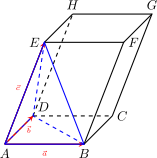
and calculated their coordinates:
$$\begin{alignat}{4}
\overrightarrow{a} &=\overrightarrow{AB} &&= B – A &&&= &&&&(1\ ;1\ ;-1)\cr
\overrightarrow{b} &=\overrightarrow{AD} &&= D – A &&&= &&&&(-1; 2; -3)\cr
\overrightarrow{c} &=\overrightarrow{AE} &&= E – A &&&= &&&&(4; -1; -2)
\end{alignat}$$
(3) Then, she calculated $\ \overrightarrow{a}\times \overrightarrow{b}\ $ as follows: $$ \begin{array}{cccc} 1&-1&1&1\cr 2&-3&-1&2\cr \hline \end{array} $$
$$\begin{aligned}
\overrightarrow{a}\times\overrightarrow{b}&=(1\cdot(-3)-2\cdot(-1); -1\cdot(-1)-(-3)\cdot1; 1\cdot2-(-1)\cdot1)\cr
\overrightarrow{a}\times\overrightarrow{b}&=(-3 + 2; 1 + 3; 2 + 1)\cr
\overrightarrow{a}\times\overrightarrow{b}&=(-1; 4; 3)
\end{aligned}$$
(4) She proceeded to evaluate $\left(\overrightarrow{a}\times\overrightarrow{b}\,\right)\cdot\overrightarrow{c}$ :
$\left(\overrightarrow{a}\times\overrightarrow{b}\,\right)\cdot\overrightarrow{c} =(-1; 4; 3)\cdot(4; -1; -2) = -1 \cdot4 + 4 \cdot (-1) + 3 \cdot (-2) = -4 -4 -6 = -14$
(5) Finally, she found the volume of the triangular pyramid: $$V = \frac13\cdot|-14|=\frac13\cdot14 = \frac{14}{3}$$
Marry concluded that the volume of the given pyramid is $\frac{14}{3}$ cubic units.
There is a mistake in Mary's solution. Where did Mary make a mistake?
The mistake is in step (1). Mary used the wrong formula for the volume of the given pyramid.
The mistake is in step (2). Mary incorrectly calculated the coordinates of one of the vectors $\ \overrightarrow{a}$, $\ \overrightarrow{b}$, $\ \overrightarrow{c}$.
The mistake is in step (3). Mary incorrectly calculated the vector product $\ \overrightarrow{a}\times\overrightarrow{b}$.
The mistake is in step (4). Mary incorrectly evaluated the mixed product $\left(\,\overrightarrow{a}\times\overrightarrow{b}\,\right)\cdot \overrightarrow{c}$.
The used formula gives the volume of a four-sided pyramid with a parallelogram base (e.g. $ABCDE$)., The volume of the triangular based pyramid (e.g. $ABDE$) is only half of the calculated volume of the pyramid $ABCDE$ (the area of the base of a pyramid with a triangular base $ABD$ is half of the area of the base of a pyramid with a parallelogram base $ABCD$). Therefore, the correct formula is: $$V = \frac16\cdot\left|\left(\overrightarrow{a}\times\overrightarrow{b}\,\right)\cdot \overrightarrow{c}\ \right|$$ The volume of the given pyramid is $\frac73$ cubic units: $$V = \frac16\cdot|-14|=\frac16\cdot14 = \frac73$$
