
In a right-angled triangle $ABC$ with hypotenuse $AB$, $\sin\,(\measuredangle BAC)=0.3$ and $|AC|=7$. Calculate the area of the circle circumscribed about this triangle.
Agnes solved this problem as follows:
(1) First she drew this picture:
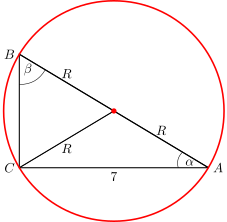
(2) Using the trigonometric identity $\sin^2\, \alpha + \cos^2\,\alpha=1$ she calculated $\cos\,\alpha$: $$ \cos\,\alpha = \sqrt{1-\sin^2\,\alpha}=\sqrt{1-0.09}=\frac{\sqrt{91}}{10} $$
(3) She knew that the cosine of an angle in a right-angled triangle is the ratio of the adjacent side to the hypotenuse, so she continued: $$ \begin{gather} \cos\,\alpha =\frac{7}{2R}\cr 2R=\frac{7}{\cos\,\alpha} \cr 2R=\frac{70}{\sqrt{91}} \cr R=\frac{35}{\sqrt{91}} \end{gather} $$
(4) Finally, she calculated the area of the circumscribed circle: $$P= \pi R^2 = \frac{175}{13}\pi $$
John solved this problem this way:
(1) He drew the same picture as Agnes.
(2) He remembered the formula: $$ \frac{|AC|}{\sin\,\beta} =\frac{|BC|}{\sin\,\alpha} =2R $$
(3) Using the Pythagorean theorem, he determined the length of $BC$: $$ \begin{gather} |BC|^2=(2R)^2-49 \cr |BC|=\sqrt{(2R)^2-49} \end{gather} $$
(4) Then he substituted $\sqrt{(2R)^2-49}$ for $|BC|$ into the previous formula and calculated the radius $R$: $$ \begin{gather} \frac{\sqrt{(2R)^2-49}}{0.3}=2R \cr \sqrt{{(2R)^2-49}}=0.6R \cr 4R^2-49=0.36R^2 \cr R=\sqrt{\frac{49}{3.64}} \end{gather} $$
(5) Finally, he calculated the area of the circumscribed circle: $$ P=\frac{49}{3.64 }\pi $$ Here are some comments from their classmates. Which one is correct?
Both Agnes and John solved the example correctly.
Agnes and John made the error in step (1). They both made the example easier by drawing side $AB$ so that it was the diameter of the circumscribed circle, which may not be the case in general.
Only Agnes solved the example correctly.
Only John solved the example correctly.
Both results are right: $$ \frac{49}{3.64}=\frac{4900}{364}=\frac{700}{52}=\frac{175}{13} $$
