
B

9000022309

Level: 
B
Using graphs of the functions \(f(x) = x^{2} + x - 1\) and \(g(x) = -\frac{1} {2}x\) solve the following quadratic inequality. \[ x^{2} + x - 1 > -\frac{1} {2}x \]
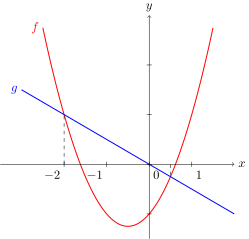
\(\left (-\infty ;-2\right )\cup \left (\frac{1} {2};\infty \right )\)
\(\left (-2; \frac{1} {2}\right )\)
\(\left [ -2; \frac{1} {2}\right ] \)
\(\left (-\infty ;-2\right ] \cup \left [ \frac{1} {2};\infty \right )\)

9000022803

Level: 
B
Establish the values of the parameter \(t\) which ensure that the equation \[ x^{2} + tx + t + 8 = 0 \] with an unknown \(x\) has complex solutions with a nonzero imaginary part.
\(\left (-4;8\right )\)
\(\left [ -4;8\right ] \)
\(\left (-\infty ;-4\right )\cup \left (8;\infty \right )\)
\(\left (-\infty ;-4\right ] \cup \left [ 8;\infty \right )\)

9000022304

Level: 
B
Find all the values of \(x\) at which the following expression attains nonnegative value. \[ x^{2} + x - 12 \]
\(x\in \left (-\infty ;-4\right ] \cup \left [ 3;\infty \right )\)
\(x\in \left [ -3;4\right ] \)
\(x\in \left [ -4;3\right ] \)
\(x\in \left (-\infty ;-4\right )\cup \left (3;\infty \right )\)
\(x\in \left (-\infty ;-3\right ] \cup \left [ 4;\infty \right )\)

9000022904

Level: 
B
Find the values of a real parameter \(t\) which ensure that the following system has a unique solution. \[ \begin{alignedat}{80} 2x & + &y & + &t & = - &2 & & & & & & & & \\ - 4x & - 2 &y & + &1 & = &0 & & & & & & & & \\\end{alignedat}\]
\(t\in \emptyset \)
\(t\in \mathbb{R}\)
\(t = 3\)
\(t = 1\)
\(t\in \mathbb{R}\setminus \{3\}\)

9000022905

Level: 
B
Find the values of a real parameter \(t\) which ensure that the following system has a unique solution. \[ \begin{alignedat}{80} tx & + &y & + &3 & = 0 & & & & & & \\4x & - 2 &y & + &1 & = 0 & & & & & & \\\end{alignedat}\]
\(t\in \mathbb{R}\setminus \{ - 2\}\)
\(t\in \mathbb{R}\)
\(t = -2\)
\(t\in \emptyset \)

9000022906

Level: 
B
Find the values of a real parameter \(t\) which ensure that the following system has a unique solution \([a,b]\) such that both \(a\) and \(b\) are positive real numbers. \[ \begin{alignedat}{80} a & - &tb & = - &2 & & & & & & \\a & + 2 &tb & = &0 & & & & & & \\\end{alignedat}\]
\(t\in \emptyset \)
\(t\in \mathbb{R}^{+}\)
\(t\in \mathbb{R}^{-}\)
\(t = 0\)
\(t\in \mathbb{R}\)