Task: Sketch the graph the function $$f(x)=3\sin\left(2x-\frac{\pi}{2}\right).$$
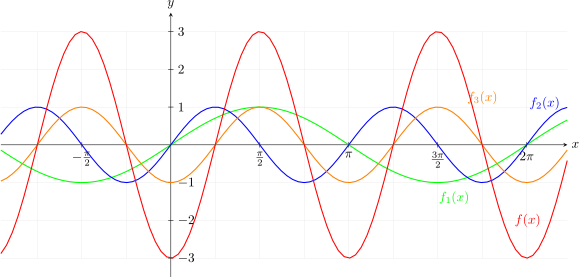
Kate sketched the graph of the function $f$ in the following steps (see the figure):
(1) Kate declared that the parent function of the function $f$ is the function $$f_1 (x)=\sin x$$ and sketched its graph (in green).
(2) She then considered the coefficient $2$ at $x$, which affects the period of the function $f$ and sketched the graph (in blue) of: $$f_2(x)=\sin(2x)$$
(3) By shifting the graph of $f_2$ by $\frac{\pi}{2}$ in the positive direction along the $x$-axis, she obtained the graph (in orange) of: $$f_3(x)=\sin\left(2x-\frac{\pi}{2}\right)$$
(4) Finally, she considered the coefficient $3$, which affects the range of the function $f$. She multiplied each function value of $f_3$ by $3$, stretching the graph of $f_3$ vertically by the factor of $3$, and obtained the resulting graph (in red) of the function $f$.
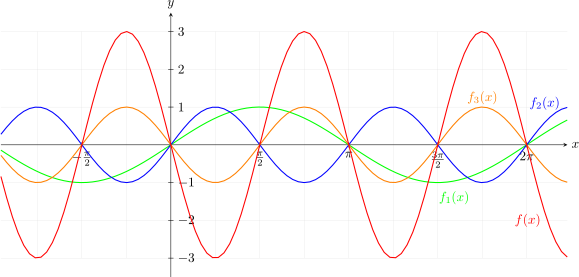
Kate made a mistake in her procedure. In which step did Kate make a mistake?
The mistake is in step (1).
The mistake is in step (2).
The mistake is in step (3).
The mistake is in step (4).
The correct graph of the function $f_3(x)=\sin\left(2x-\frac{\pi}{2}\right)$ is obtained by shifting the graph of $f_2$ along the $x$-axis by a value that is determined through the following modification of the equation for $f_3$:
$$f_3(x)=\sin\left(2x-\frac{\pi}{2}\right)=\sin\left[2\left(x-\frac{\pi}{4}\right)\right]$$ So, the graph of $f_3$ is obtained by shifting the graph of $f_2$ by $\frac{\pi}{4}$ in the positive direction along the $x$-axis (i.e., in the direction "opposite" to the sign of the constant $\left( -\frac{\pi}{4}\right)$).